When we move from organizing work in projects to working in product teams, it is not only the organizational structure that changes. The logic behind how we prioritize, plan, organize, and track the work also needs to change.
It is easy to change the language and structures without changing the underlying logic. Requirements become Epics, project plans become Product Backlogs, and new ways of visualizing the work are introduced, while we continue to make decisions and manage the work much as we did before.
From the outside, the organization may look very different. But underneath, familiar assumptions can remain. We still decide solutions early, classify what should fit into scope, break predefined solutions into smaller pieces, let a few people plan for everyone else, and track whether the planned work gets done.
The terminology has changed. The structures have changed. But the logic for managing the work has not.
These are traps I repeatedly see in that shift.
| Trap | Project logic | The shift | The trap |
|---|---|---|---|
| The Solution Prioritization Trap | We prioritize which requirements and solutions should be included in the project. | Prioritize the outcome we want to achieve before prioritizing what to build. | We may replace requirements with Epics, but we continue to prioritize what to build. |
| The Classification Trap in Prioritization | We classify what must, should, or could be included in the project scope. | Compare the desired outcomes and decide which one should get our focus now. | We classify each Epic as High, Medium, or Low, but do not decide what should come first. |
| The Negotiation Trap in Prioritization | We prioritize from different parts of the organization’s perspectives and negotiate what gets capacity. | Prioritize together based on what matters most for the whole. | We bring the work together in one shared backlog, but continue to prioritize through negotiation between different parts of the organization. |
| The Work Breakdown Trap | We break down a predefined solution into smaller parts that together need to be built. | Start from the desired outcome and build a small, working slice. Use feedback to see whether we are moving in the right direction, and let learning guide what we build next. | We call the whole an Epic and the parts Stories, but we are still breaking down a predefined solution. |
| The Planning Efficiency Trap | A few people plan the work for everyone else in an effort to use people’s time efficiently. | Bring the relevant perspectives together when decisions need to be made and the knowledge is available. | The project plan becomes a detailed backlog, but a few people are still doing the thinking for everyone else, far in advance. |
| The Control Trap | We organize the work in a plan and track whether it gets done. | Organize around desired outcomes and use transparency to see what the work leads to, what we are learning, and what we need to do next. | We replace the project plan with product structures, but still use them to organize and track the work. |
What connects these traps is the risk of changing the visible structures without changing the assumptions behind them. We can call something an Epic and still treat it as a large requirement. We can have a Product Backlog and still use it as a project plan. We can have product teams and still decide their work far in advance.
Moving to product teams does not mean that planning, requirements, delivery or making work visible no longer matter. It changes what we use them for.
The challenge is not adopting the structures of product teams. It is recognizing when we are using those structures to reproduce the logic of projects.
See the bigger picture
These traps focus on how we organize and manage work. The move from projects to product teams affects many other parts of the organization as well, including strategy, governance, funding, teams, culture and organizational structure.
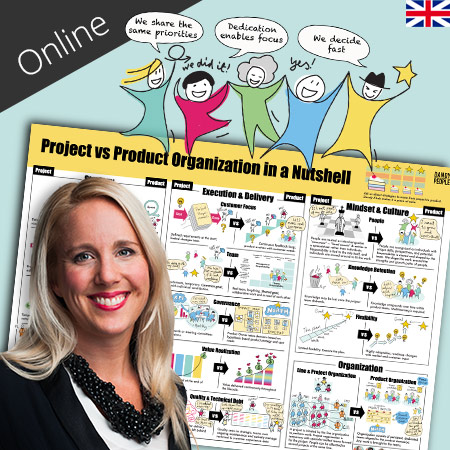
Our Project vs Product Organization in a Nutshell poster explores this broader shift from several perspectives.