| How to define: |
| *Artificial intelligence refers to systems that learn from data and support or automate decision-making processes that would otherwise require human judgment (Shrestha et al., 2019). In organizations, this means that AI increasingly becomes part of how decisions are made, how work is coordinated, and how value is created. The AI-Act is the legal framework on AI worldwide. It defines AI as a machine-based system designed to operate with varying levels of autonomy that may exhibit adaptiveness after deployment and that, for explicit or implicit objectives, infers from the input it receives how to generate outputs such as predictions, content, recommendations, or decisions that can influence physical or virtual environments. (EU AI Act, Article 3) In this article, AI is used as a general term for both traditional AI and generative AI, with a focus on how the technology influences the way organizations make decisions, collaborate, and create customer value, rather than on specific tools or solutions. **Digitalizing core processes means making the processes where the organization interacts with customers and makes critical decisions fully digital, so that information, decisions, and actions are connected without manual steps that slow down the flow e.g. handovers between units. Two common pitfalls: The customer-facing layer is digital, while the underlying core process remains largely manual; The supporting processes, reports, or ways of working are digitalized within a silo function. The core process is defined as the driver of business value. Disclaimer: There are several ways to define AI. The chosen definitions here, are used to clarify the purpose and perspectives of this blog post. |
Introduction
This article builds on insights from my studies in AI*, innovation, and organizational design at Halmstad University, combined with experiences from my everyday work as an Enterprise Coach at Dandy People. It has been more than a year since I completed the program, yet many of the insights have become increasingly relevant as AI has taken a more prominent place in organizations’ strategic agendas. I have reflected and found a few things that feel particularly relevant right now, especially regarding the organizational capabilities that are often overlooked when the focus shifts to the next trend or solution meant to address the challenges at hand, beyond methods and frameworks.
During the program, we worked with research on AI, decision-making, organizational structures, and innovation (product and service innovation) as part of broader systemic changes in organizations. For me, this provided new perspectives on questions I already face in my profession: how organizations are designed, how value is actually created, and why so many large and ambitious initiatives lose momentum along the way – especially regarding the organizational capabilities that are often forgotten when the focus shifts to the next trend, the next tool, or the next framework.
This article takes a clear perspective: organizational structure and design, operating models, and digitalization. Other equally important aspects—such as data security, regulatory issues (Candelon et al., 2021), or the cognitive and emotional dimensions of AI and trust (Glikson & Woolley, 2020; Huang & Rust, 2021)—require deeper exploration and may become topics for future blog posts.
AI Investments as Part of Systemic Change
AI is becoming one of the most significant organizational investments of our time. Not because the technology itself is expensive, but because it requires us to rethink how and where decisions are made, how we collaborate, and how we think about customer value.
The pattern I often see is that when organizations say they are “investing in AI,” they usually mean investments in models, platforms, tools, or external consultants who support implementation. At the same time, the structural and cultural investments required for a real transformation are underestimated.
In practice, this is closely connected to something I often observe in different client assignments: a tendency to simplify organizational challenges by searching for quick and easy solutions in technology and tools.
AI is therefore easily reduced to a question of implementing new technology or introducing a new way of working, rather than addressing the underlying structures, incentives, and behaviors that actually need to change—and which are inherently more complex in its nature.
Misguided investments can be costly for organizations, not only from legal, ethical, and business perspectives, but also in terms of employee insecurity and bias in data (van Giffen et al., 2022).
What has become increasingly clear is that AI cannot be treated as just another organizational “trend” that companies rush to adopt in order not to miss out. Just as with previous waves such as digitalization, DevOps, agile practices (particularly large-scale frameworks), and data—AI requires a shift in how organizations are designed and governed.
This is where competence in organizational design and operational transformation becomes crucial. I do not mean simply introducing a framework or scaling a method, but actually changing structures, mandates, and ways of working.
Signs that organizations struggle to build long-term capabilities include numerous initiatives, experiments, and pilots that stall, attempts to scale that lose momentum, and an organization where trust in the transformation effort gradually declines and eventually erodes altogether.
AI Reveals and Amplifies What Already Exists
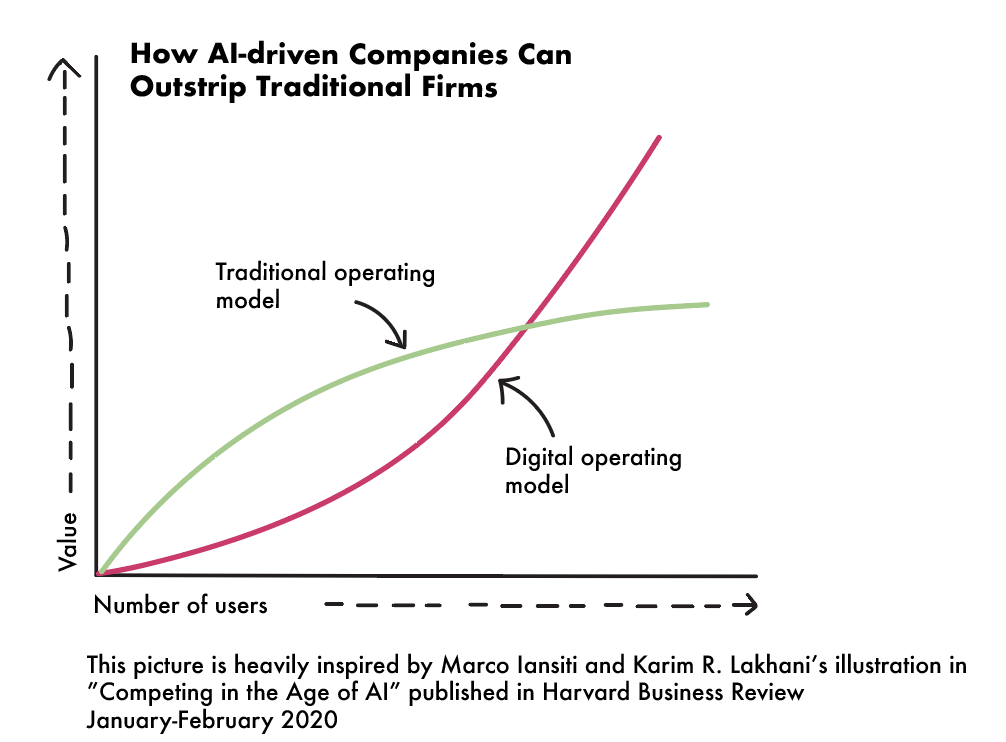
In Competing in the Age of AI, Iansiti and Lakhani (2020) describe a decisive difference between companies that succeed with AI and those that do not – their core business processes are digitalized end-to-end, with minimal friction between data, decisions, and action. Without that shift, AI initiatives risk delivering limited impact and even worse, amplifying the very issues and dysfunctions that already exist. This is also highlighted in the DORA Report 2025 and its AI Capabilities Model.
Without a sufficiently strong foundation, AI will accelerate the existing culture and structures of an organization (for better and for worse). The technology itself rarely creates problems, but it makes existing patterns more visible. A few examples illustrate this:
- When AI is implemented within functions, it tends to optimize locally around specific processes without considering the broader system. The result is simply more efficient silos.
- When AI is trained on historical data, it reproduces the decisions, priorities, and structures that have shaped the organization in the past. In doing so, AI reinforces the organization’s history—its power structures, priorities, decisions, interpretations, incentives, shortcuts, and compromises. The result can lead to leadership communicating a new direction while the AI is trained on the existing setup.
- When AI generates insights faster but the organization remains stuck in structures characterized by manual handovers, reports, meetings, unclear responsibilities, unclear decision paths, and strong boundaries between organizational units, the result is better analysis but no faster execution and no increased ability to act.
- When AI is introduced in a context designed primarily for control, compliance, and reporting, the technology is also likely to be used mainly for monitoring, reporting, and optimization. In such cases, AI reinforces a “control culture,” with centralized decision-making and reduced autonomy where decisions should instead be made closer to where value is created.
Why Digital Organizations Can Scale
A recurring pitfall is that digitalization is treated as an IT- or change initiative alongside the business, rather than as part of its core operations. When this happens, the business-critical flows remain manual and fragmented. But an organization cannot be agile without a stable core. Only when the core processes are digitalized end-to-end (from the customer interaction through to internal operations) do short feedback loops, learning, and rapid adaptation become possible (Davenport & Ronanki, 2018).