So proud of my team, Boom X (two generations of hackers), for fearlessly joining the SAAB Smart Airbase Hackathon this weekend! So much fun—and so much learning 👏
Being part of this event and working as a small product team at the forefront of vibe coding and AI-supported development was an incredible experience.
I would recommend this to anyone curious about how cutting-edge technology can be used to solve real customer problems. When vibe coding in a small product team, you end up innovating across all layers at the same time. You can truly work user-experience first—focusing on the customer problem, quickly delivering prototypes and end-to-end scenarios, and getting feedback that immediately impacts both the product and the evolving business strategy.
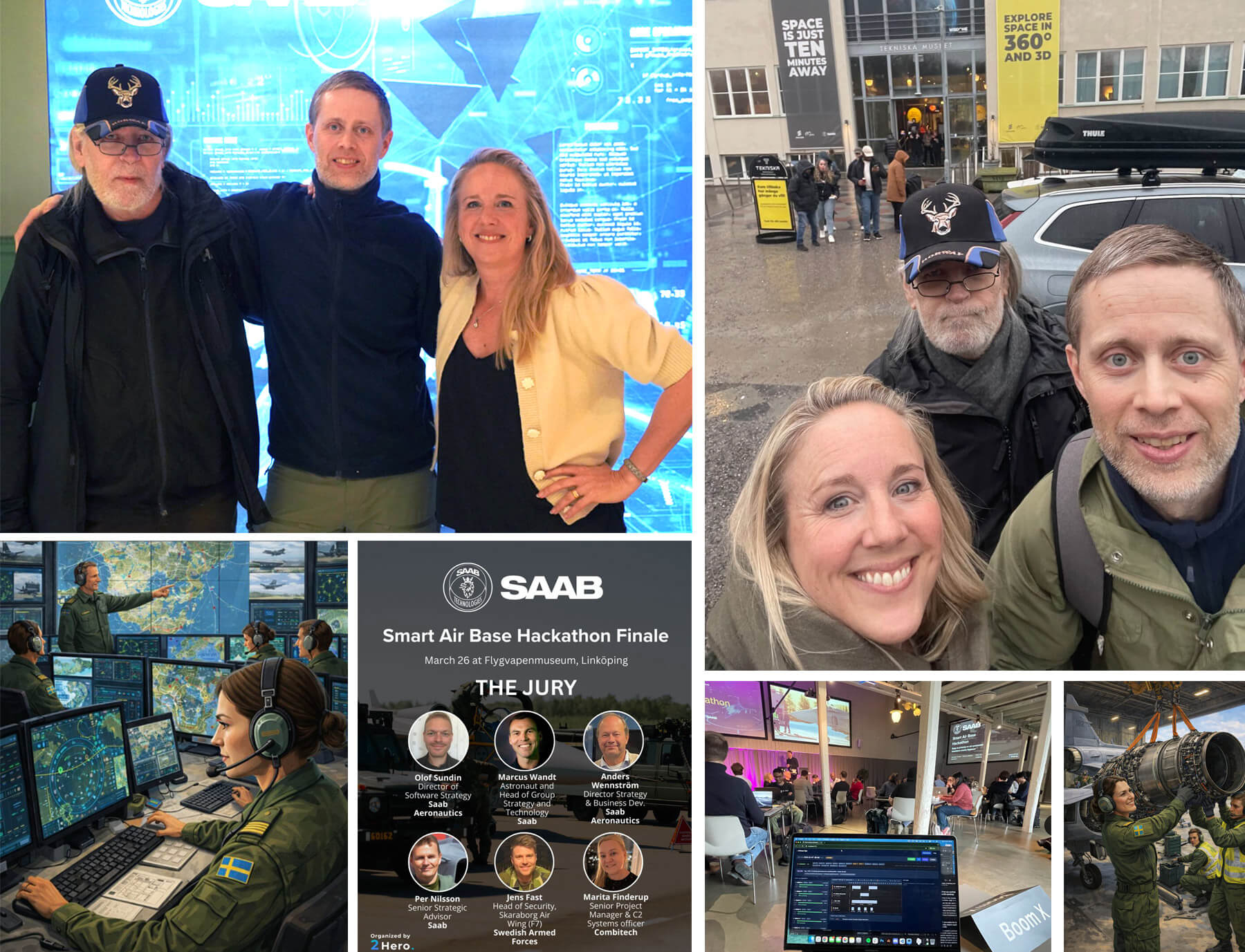
I learned a lot myself—making my first ever pull request and pushing to Git. As a former designer, product owner, and chief product owner, I’ve never really been that hands-on with coding until I started experimenting with Lovable about six months ago. This time we used VS Code, a more “hardcore” version of vibe coding. Luckily, I had my brother Daniel Blom on the team. He does full-stack AI-enabled development for a living—and, luckily for me, he also has enormous patience. 😉
Starting early by aligning on the customer problems we wanted to solve and agreeing on a shared strategy was crucial. So was defining the structure for the processes we were digitizing: the rules, the information flows, and what success would look like. We also used quick paper prototyping to create a shared foundation.
When everyone in a team can work simultaneously on the same product—with interconnected user scenarios and AI superpowers—product strategy becomes what makes or breaks your efforts. Even if you throw away prototypes or do work that ends up unused, you are still moving closer to creating value, as long as you focus on the most important customer problems.
The only thing that made me a bit frustrated during this otherwise amazing experience was having to work with a slower, less capable AI model after getting used to the best ones. 😅 That really threw me off. Suddenly, instead of giving me superpowers, the AI created more work—misunderstandings, friction, and unnecessary effort.
The short 5 min demo video of the prototype
This was the video the jury got to select the five finalist teams. Our team wasn’t among those five, but we were invited to the event in Linköping, which was a great experience in itself.
The impact of short time boxes
The impact of extremely short timeboxes, like in a hackathon, is remarkable for creativity. At the same time, without deep domain knowledge and context, it’s hard to know whether you’re solving the most important problems—or solving them in the right way. Everything remains a hypothesis until it’s tested and proven in reality.
Our idea in short
Our concept had four parts:
1. A digitized simulation environment
We proposed building a digital simulation (inspired by a board game) where personnel at the airbase can train decision-making under pressure. Ideally, this would be as close to reality as possible—or even use the same interface as the real system.
2. Role-based user perspectives with AI support and Human in the Loop
The system adapts to different user roles, providing tailored views depending on context. AI would support decision-making in high-VUCA environments, help users stay updated, and highlight when critical information is missing—or where to get it. We made a decision early on to keep the human in the loop, meaning AI would not make decisions only provide suggestions for imput of data and decisions.
3. Continuous development through simulation
The simulation could act as a test environment to continuously evolve the system based on real needs. By training and building at the same time, developers and users work closely together—enabling fast, customer-focused product development. The airforce could then choose when to adopt new capabilities.
4. A new way of working
This approach could enable a new way of developing and operating software within the Swedish Air Force—and potentially across other parts of the military—together with partners such as SAAB.
Could events like this enable a better world?
My hope is that more managers and executives get to experience this firsthand. Spend just a day or two working alongside your teams, and you will quickly realize that giving them access to the best tools available is one of the most important strategies you can have. Any organization that locks itself into long-term contracts with only one—or just a few—AI models (even if they are the best today) will soon need to reinvest. The AI landscape is evolving incredibly fast, and staying flexible is key to unlocking these new superpowers.
All organizations who want to benefit from AI must adapt their decision making and their operational model. Maybe hackathons can be that high speed segway into the future most organizations need? A way to experience how AI-enabled product development can be done cross functionally – and also development of AI-tools? What if new systems can be built at high speed based on real user needs (not old specifications) – and in a safe way be tested? Could we then replace old legacy systems at speed too?
A big thanks to Olof Sundin and the team at SAAB and the Swedish Air Force for creating such a positive, energetic, inclusive and inspiring event!
I hope that many more will come and that the learnings will enable positive outcomes and a more safe world for everyone!