This poster came to life based on common misunderstandings we have seen over and over again in organizations starting on the journey to become more product centric and outcome oriented. We hope that the poster can bring light to these patterns and support valuable dialoges around them.
We have vizualized some of the important patterns and missunderstandings – not all of them. The poster covers 4 important areas, Strategy, Execution and Delivery, Culture and Organization.
The culture shift is the result of the shifts made to enable, support and incentivise new behaviours connected to outcome and a trust based leadership. These new behaviours will only be possible if the structure is shifted to the right, on the product side.
Maybe you have already done some of these shifts? What else could be needed to move towards a more customer centric outcome oriented culture? Who do you need to collaborate closer with? Bring them together and discover the shifts using this poster and the insights shared in the short videos below here.
Download the poster for free (HIGH REZ PDF) >

Short videos covering each topic in the poster
The team behind the poster; Elinor Lange, Frank Olsen and Mia Kolmodin together with Johan Westerlunch and Natalja Calderon guide you through each topic during a short video. This served as our Christmas Calendar when we launched the poster in december 2025.
Customer Focus
In this video we dive into one of the most fundamental, and probably most misunderstood, topics in modern organizations: Customer Focus.
Topics explored
- Many organizations believe they are customer-centric. But when it’s time to make real decisions, customer needs often fall behind internal priorities, project plans and budget structures.
- Why customer focus tends to fade in traditional project organizations
- How product organizations keep customer needs at the center – continuously
- Why product-oriented ways of working lead to stronger outcomes and better value delivery, for both customer and the business.
Funding Model
Topics explored
- How the funding model impact the product development – and what you could do to shift towards product.
- How project oriented funding often cause problems with knowledge retention which delay deliveries and also difficulties to deliver customer and business value.
- How incremental funding might be a better fit for many organizations.
- What organizations have done to get started moving towards a product oriented funding model.
People
Topics explored
- In project based organizations we tend to call people “recourses”. How shifting perspective to “people” and what lies behind that, changes everything and we build stronger teams, higher engagement, and a culture that supports real product-led ways of working.
- When reduce people to abstractions, we also reduce commitment, trust, and ownership. Words matter — because they shape how we lead.
- One of the reasons product organizations succeed is because people are empowered — not managed as resources.
Core values
In this video we explore the fundamental difference in view of core values in a project vs product organization.
Topics explored
- Many project-driven organizations emphasize predictability, plans, and control.
- Success is defined by adhering and delivering to the plan, and change is often seen as a disruption rather than an opportunity.
- Embracing learning and adaptability, often by fast feedback loops.
- Focus on time-to-money, on delighting customers, and on creating long-term, sustainable value.
- It’s a shift from valuing the plan to valuing the ability to learn and improve, and in doing so making the customer happy.
- Shifting to a product-driven way of working isn’t about abandoning structure, it’s about investing in learning, adaptability, and customer value.
- When we value customer needs over plans, we create organizations that move faster, make smarter decisions, and build products people truly love.
Ownership
In this video we explore how ownership works differently in project vs. product organizations.
Topics explored
- In project organizations, ownership often sits with the project manager, who controls tasks. This removes responsibility from the people doing the work, leading to lower motivation, less creativity, and a focus on delivering the project rather than improving the product.
- Modern product organizations distribute ownership to the teams closest to the problems. With mandate, involvement, and a focus on product outcomes, motivation increases and problem-solving thrives. And this leads to happier, engaged people and product success.
- Real ownership fuels motivation, creativity, and better products. Give responsibility to the people who can actually make a difference.
The team
In this video we explore how the prerequisites for, and use of, teams differ in project vs. product organizations.
Quality and Technical Debt
In this video we explore how quality and technical debt is handled differently in project vs. product organizations.
Topics explored
- In project organizations, focus is to deliver a fixed scope at a fixed deadline – with a high risk to build lower quality. And often the responsibility is separated from the responsibility for delivery, which makes it harder to build in quality.
- In modern product organizations the product teams are accountable for the quality AND delivery. They then have the possibility to build in quality in the work they do to deliver the product which can be done iteratively and incrementally – to meet the deadline. Here they can focus first on quality FIRST and THEN on the delivery which gives a sustainable pace and product.
Knowledge retention
In this video we explore how knowledge is built, kept, and used differently in project vs. product organizations.
Topics explored
- In project organizations, teams are often temporary. When a project ends, the team disbands and so does much of the knowledge. Valuable insights fade, and organizations find themselves reinventing solutions again and again.
- In modern product organizations, teams stay with the product over time. Knowledge compounds, learning accelerates, and problem-solving becomes faster and more effective. Multi-learning across skills and roles strengthens the team’s ability to deliver long-term value.
Primary objective
In this video we explore how the primary objective differ in project- vs. product organizations and what impact that has on delivery and the business value from the delivery.
Value realization
In this video we explore how value is perceived differently in project- vs. product organizations – and how that may impact the business outcome.
Flexibility
In this short video we explore how flexibility is perceived differently in project- vs. product organizations – and how you can enable it and benefit from having both flexibility in the solution – and strategic flexibility.
Time horizon
In this short video we explore what project vs product organizations tend to focus on, and put their effort into, based on the time perspective.
They also share how you can start moving towards a product perspective.
Organization
In this short video we explore how project vs product organizations tend to look like and work and why many organizations fail in their ambitions to become more product- and customer centric when they don’t adapt their organization.
You’ll also get a few tips on what you can do to start to move towards becoming more product oriented.
Dandy X-Lab – a structured way to make the shifts
Join us in this short video where we share both success cases doing this change – and the model, Dandy X-Lab. Dandy X-lab is designed to enable increased business value sooner together with our customers.
This is the most effective way to handle the transition from a project based organization to product oriented that we have ever seen. No more big bang, high risk and slow and unsecure ROI on change initiatives and business innovation as we connect customer centric innovation & delivery to the organizational development.
When the structures, WoW and management are working FOR your people, they will become the super heroes they are and we make that happen within a short time boxed period of time showcasing that it works. At the same time we build a bespoke scalable operational model for YOUR context.
This model is proven to work within all type of organizations and businesses.
Free to download, use and share
The posters are published under Creative Commons License, so please use it and share it as you like. If you are interested in doing a translation to any other languages, please let me know and I will help you with the file and publish it here on the blog as well.
You are free to:
Share — copy and redistribute the material in any medium or format
Adapt — remix, transform, and build upon the material for any purpose, even commercially.
This license is acceptable for Free Cultural Works.
The licensor cannot revoke these freedoms as long as you follow the license terms.
Under the following terms:
Attribution — You must give appropriate credit, provide a link to the license, and indicate if changes were made. You may do so in any reasonable manner, but not in any way that suggests the licensor endorses you or your use.
ShareAlike — If you remix, transform, or build upon the material, you must distribute your contributions under the same license as the original.
No additional restrictions — You may not apply legal terms or technological measures that legally restrict others from doing anything the license permits.
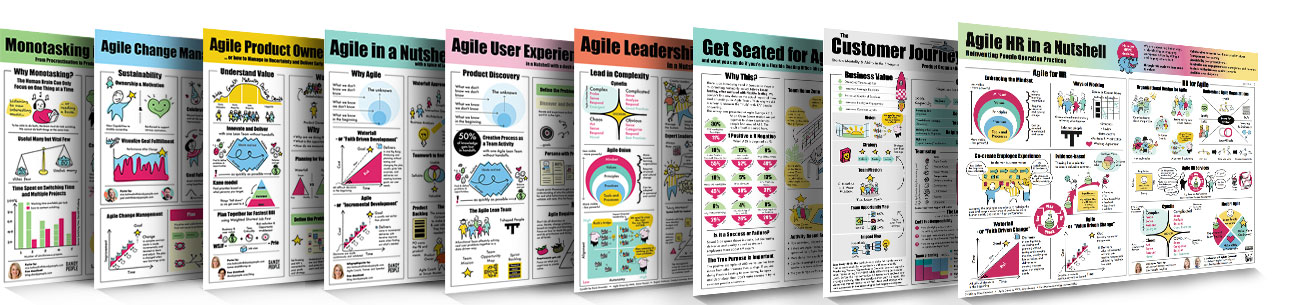
Here you find all the other Free Agile in a Nutshell-posters in the series that is now translated to 15 languages and downloaded over 100.000-times worldwide.